What Is the Dark Web
The dark web is a portion of the internet that requires specific software to access, most commonly Tor Browser. It's built on encrypted routing that bounces your connection through multiple relays, obscuring your IP address and location. The dark web itself is neutral infrastructure—it's neither inherently legal nor illegal. Journalists use it to communicate securely, activists use it to bypass censorship, and researchers study it to understand privacy technology. The Tor Project maintains the software that powers most dark web access. What makes the dark web different from the regular web is anonymity by design, not the content hosted there.
What Is a Black Market
A black market is any marketplace where illegal goods or services are traded. Black markets exist on the dark web, on encrypted messaging apps, in person, and sometimes on the regular internet using obfuscation techniques. The key characteristic is the activity—the exchange of contraband—not the location or technology. Black markets have existed for centuries, long before the internet. They operate outside government regulation and law enforcement oversight. Some black markets are highly organized with reputation systems and escrow services; others are chaotic and prone to scams. The dark web provides anonymity that makes black markets harder to trace, but the black market itself is defined by what's being sold, not where it's hosted.
Dark Web vs Black Market: Core Distinction
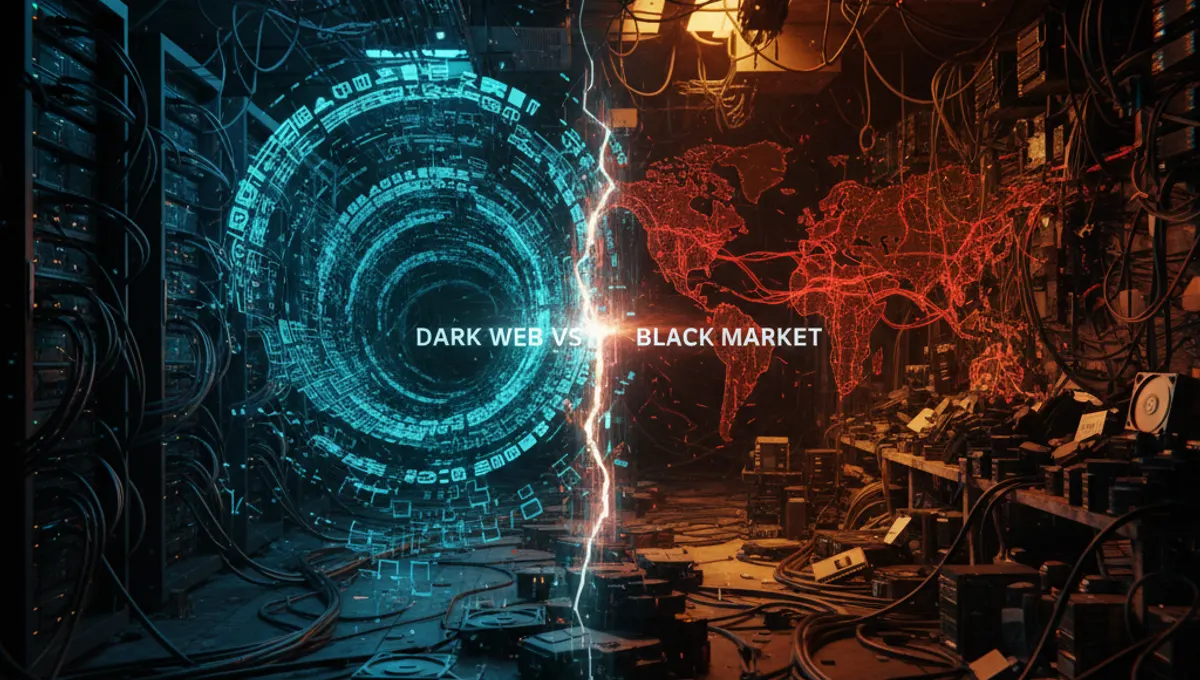
Think of it this way: the dark web is a tool; a black market is an activity. You can use the dark web for legal purposes—reading uncensored news, secure communication, privacy research—without ever touching a black market. Conversely, black markets existed before the dark web and continue to operate through other channels. The confusion arises because black markets have migrated heavily to the dark web due to the anonymity it provides. But the dark web hosts legitimate forums, libraries, email services, and communication platforms. Understanding this distinction helps clarify that accessing the dark web isn't inherently illegal, though many black market activities are. The technology and the misuse of that technology are separate things.
Dark Web vs Deep Web vs Black Web: Related Terms
The deep web is any part of the internet not indexed by standard search engines—this includes your email inbox, medical records, and academic databases. It's massive and mostly mundane. The dark web is a small, intentionally hidden subset of the deep web. The black web is sometimes used as a synonym for the dark web, though it more accurately refers to the dark web's association with illegal activity. These terms are often conflated in casual discussion, but they have distinct meanings. The deep web is largely legal and everyday; the dark web is a privacy-focused network; the black web is a characterization of illegal activity. Knowing these distinctions prevents misunderstanding when reading about internet security or anonymity.
Dark Web vs Dark Net: Terminology
Dark web and dark net are essentially the same thing—both refer to encrypted networks requiring specific software to access. Dark net is older terminology; dark web is more common now. The Tor network, I2P, and Freenet are all examples of darknets. When people say dark web, they usually mean Tor specifically, since it's the largest and most accessible. Dark net is a broader term that encompasses multiple technologies. Neither term implies illegal activity by default. The terminology matters when you're reading technical documentation or security research, as different darknets have different architectures and use cases. For most purposes, dark web and dark net can be used interchangeably, though dark web is more widely understood.
Dark Web vs Regular Web: Access and Anonymity
The regular web (also called the surface web or clearnet) is what most people use daily—Google, social media, news sites. Your IP address is visible to these sites unless you use a VPN. The dark web requires Tor Browser or similar software to access, and your IP is routed through multiple encrypted relays. On the regular web, your identity is tied to your IP unless you take steps to hide it. On the dark web, anonymity is the default. However, the regular web is faster, more stable, and hosts the vast majority of legitimate content. The dark web is slower due to routing complexity and hosts a smaller, more specialized set of sites. Neither is inherently better—they serve different purposes. The regular web is for general browsing; the dark web is for privacy-critical communication and research.
Security and Anonymity Considerations
If you're accessing the dark web for legitimate reasons—research, privacy, uncensored communication—use Tor Browser directly from the official Tor Project website. Combine it with a VPN for additional protection, though this adds complexity. Never maximize your browser window on the dark web, as this can leak your screen resolution. Don't enable plugins or extensions unless you understand the security implications. Don't assume anonymity is absolute; law enforcement has successfully de-anonymized Tor users through operational security mistakes and technical exploits. Keep your operating system and software updated. Consider using a dedicated device or virtual machine for dark web access. Understand that visiting the dark web itself is legal in most jurisdictions, but many activities conducted there are not. The tool is neutral; how you use it determines legality and safety.
Frequently asked questions
Is accessing the dark web illegal?
Accessing the dark web itself is legal in most countries. Using Tor Browser to reach .onion sites is not a crime. However, many activities conducted on the dark web—buying illegal goods, distributing contraband—are illegal. The tool is legal; the misuse may not be.
Are all dark web markets black markets?
No. The dark web hosts forums, libraries, email services, and communication platforms used for legitimate purposes. Black markets are a subset of dark web activity. Many dark web sites have nothing to do with illegal commerce.
What's the difference between the dark web and the deep web?
The deep web is any internet content not indexed by search engines—email, medical records, academic databases. The dark web is a small, intentionally hidden subset of the deep web requiring specific software like Tor to access. Most of the deep web is legal and everyday.
Can I be traced on the dark web?
Tor provides strong anonymity, but it's not perfect. Law enforcement has de-anonymized users through operational security mistakes, malware, or technical exploits. Maximize your browser window, use a VPN, keep software updated, and avoid revealing personal information.
Why would someone use the dark web legally?
Journalists communicate with sources securely, activists bypass censorship, researchers study privacy technology, and people in oppressive regions access uncensored information. Privacy is a legitimate need in many contexts.